For factories, hotels, farms and commercial buildings: rack and high-voltage LiFePO4 systems that shave peaks, ride through outages and store midday solar for the evening shift.
Commercial energy storage is bought on a spreadsheet: demand charges avoided, outage hours survived, solar kilowatt-hours self-consumed. The hardware on this page — the manufacturer's rack-mounted 51.2V systems and high-voltage rack series — is the part of that spreadsheet you install in a plant room and forget about.
Rack-mounted units (100Ah and 200Ah at 51.2V) parallel into cabinet systems for small and mid-size commercial sites, while the high-voltage rack series serves larger installations where a higher DC bus cuts current and cabling losses. Both formats carry the range's communication standard — RS485 and CAN — for integration with energy management systems and hybrid inverters.
Every commercial project is quoted per project: load profile, tariff structure, backup requirement and site constraints go in, and a written specification with module counts, inverter matching and expected duty comes out. The company profile states its products are sold to 50+ countries; export documentation and the published certification types for each model are confirmed in the quote.
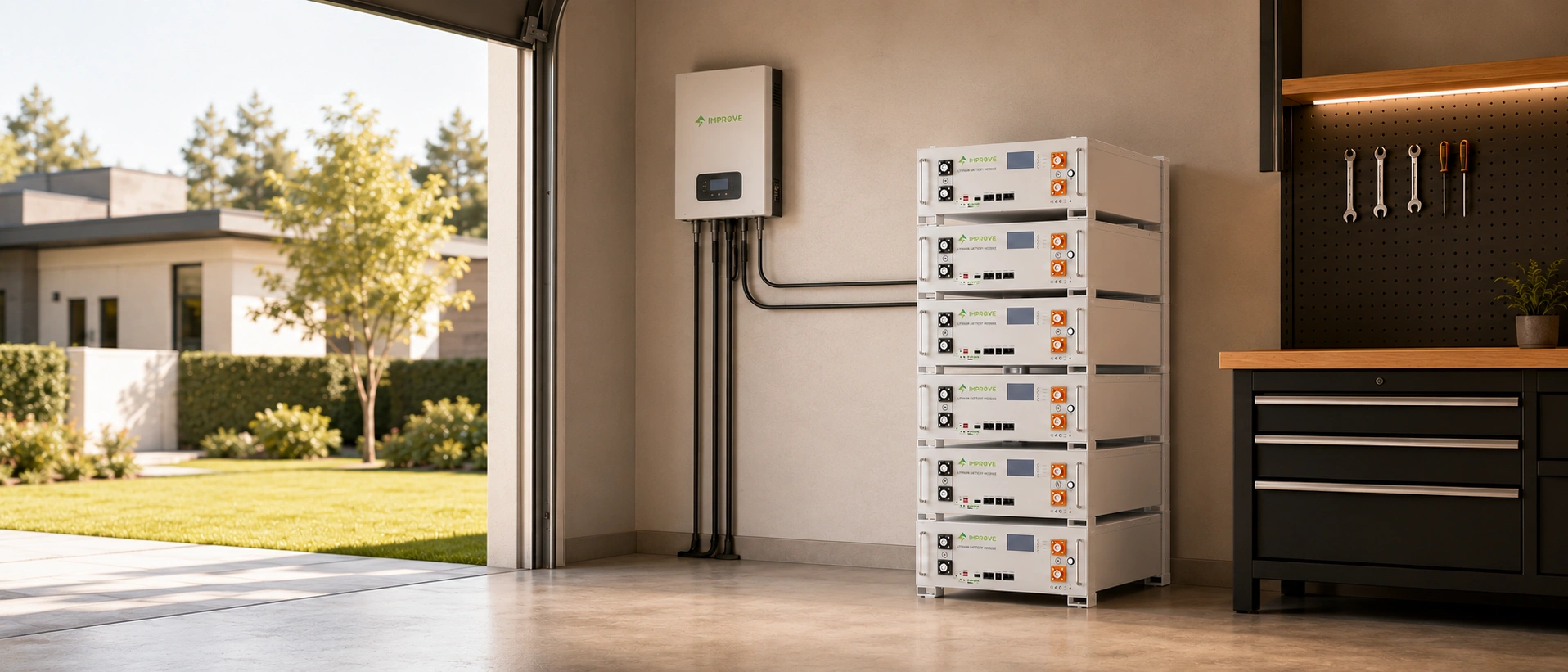
| Formats | Rack-mounted 51.2V 100Ah / 200Ah; high-voltage rack series; cabinet configurations |
|---|---|
| Unit energy | 5.12kWh (100Ah) and 10.24kWh (200Ah) per 51.2V unit |
| Communication | RS485 / CAN for EMS and inverter integration |
| Cycle life | 6,000 cycles or more at 80% DOD on published residential/rack datasheets; project models confirmed per quote |
| Duty | Daily cycling for peak shaving and solar self-consumption |
| Certification (published) | Model-dependent; certificates available upon request |
Figures are the manufacturer's published data for this range. The written quote states the exact configuration of your build.
Demand charges are billed on your worst 15–30 minutes of the month. A battery that discharges through the peak window attacks the most expensive line on the bill.
Unlike a generator, a storage system earns on ordinary days — solar shifting and peak shaving — and still covers the outage days.
Standard rack formats keep installation, expansion and service simple: identical units, front access, documented communication.
Commercial sizing is a calculation, not a catalogue pick. Quotes state assumptions and expected duty in writing.
Sites with a wide gap between peak and off-peak tariffs, sites paying demand charges, and sites whose solar array exports at midday while the building buys back energy in the evening. Hotels, cold storage, workshops with daytime machinery peaks and farms with pumping loads are the recurring profiles in this range's enquiry book.
The second payback is continuity: a production line or cold room that rides through a two-hour outage avoids losses that dwarf the energy bill. Backup sizing for commercial loads follows the same load-profile method as residential backup, with three-phase configurations available in the published stackable system data.
Low-voltage 51.2V racks are the flexible default for small and mid-size systems: modular, widely inverter-compatible, easy to expand. High-voltage racks earn their place as capacity grows, because higher bus voltage means lower current for the same power — thinner cabling, less loss, cleaner large-system design. The crossover is a project calculation; send the target capacity and we will specify both ways in the quote.
Minimum order quantities and lead times depend on the product type and the degree of customisation: standard products can start from smaller batches, while custom housings, labelling and packaging are assessed per project. Samples can be arranged, with sample and freight costs confirmed against the requirement. Every enquiry is answered with a written specification and quote stating the model, configuration and terms - nothing about an order here is left to chat messages.
Improve Battery runs OEM/ODM alongside its standard range, and ships with the export documentation each model carries (CE, RoHS, FCC, MSDS, UN38.3 types as listed per datasheet; certificates available upon request). State the model, voltage, quantity and destination in the enquiry form and the sales team in Shenzhen will reply with the full specification.
Send the inverter make and model. Communication compatibility over RS485/CAN is confirmed in writing before any order — never assumed.
Start from the load profile: peak demand, the hours above your tariff threshold, and the loads that must survive an outage. Most first systems land where those three curves intersect; the quote shows the arithmetic.
These systems are specified for it. Published cycle ratings of 6,000+ cycles at 80% DOD are the basis of the project economics we quote.
The manufacturer runs OEM/ODM alongside standard products. State the branding and configuration requirements in your enquiry; feasibility and terms are confirmed per project.
Model, voltage, quantity and destination - that is all a real quote needs.