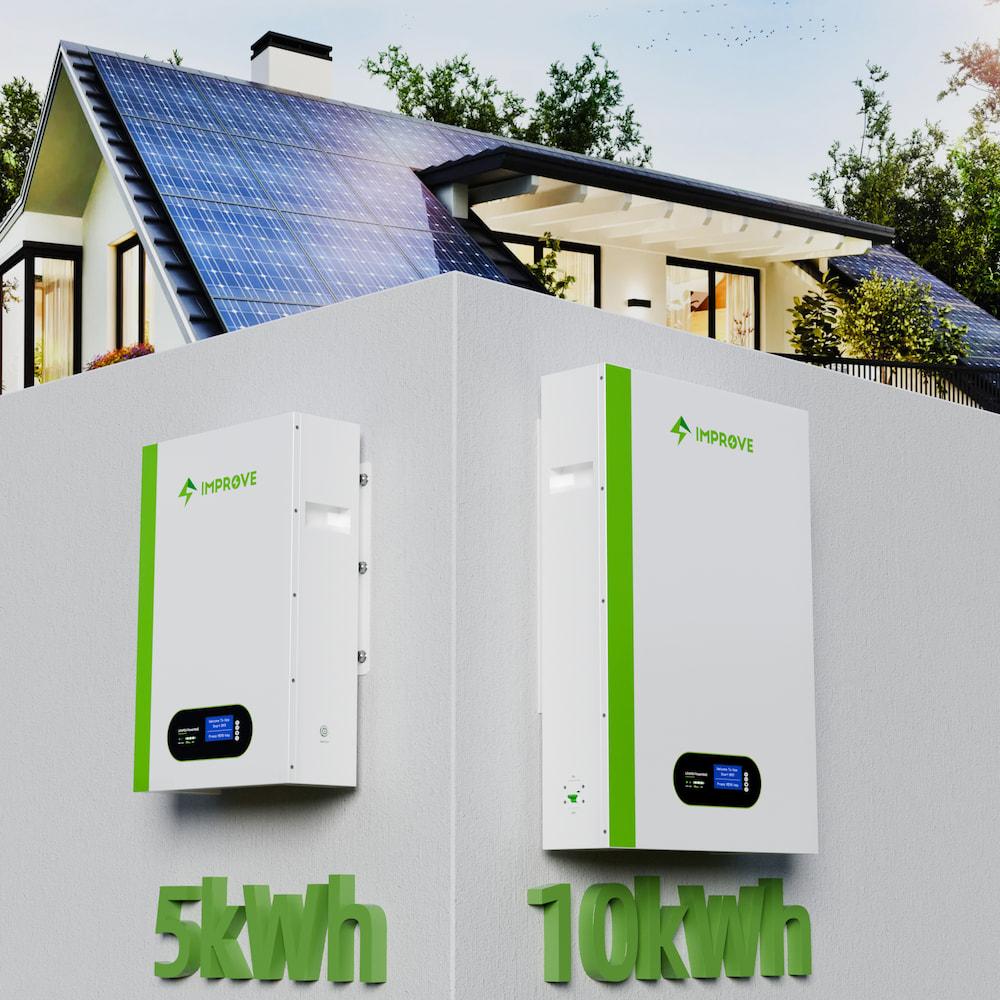
Two wall-mounted units — 5.12kWh and 10.24kWh — in cabinets only 145mm deep. The specification plate below is the manufacturer's published data for the IMP-LW-05B and IMP-LW-10B.
A powerwall earns its wall space. The IMP-LW-05B stores 5.12kWh (51.2V, 100Ah) in a 615 × 420 × 145mm cabinet at 52kg; the IMP-LW-10B doubles that to 10.24kWh (200Ah) at 800 × 550 × 145mm and 86kg. Both charge at 58.4V, cut off discharge at 43V, and carry a 6,000-cycle rating at 80% depth of discharge — the figure that decides what a stored kilowatt-hour actually costs over the system's life.
Standard charge and discharge run at 20A and 50A, with maximum continuous charge and discharge of 100A on both models — and on the 200Ah unit, 200A is available as an option for high-draw homes. Up to 15 modules parallel, so a wall that starts with one 10.24kWh unit can grow to a serious whole-home store without changing format. Communication is RS232, RS485 or CAN, and Bluetooth, Wi-Fi and a heater are published options.
For distributors, the powerwall is the residential line's front door: two SKUs, a clean wall aesthetic, and a datasheet complete enough to drop straight into a tender. Private labelling and enclosure options are configured at order level.
| Models | IMP-LW-05B (100Ah) · IMP-LW-10B (200Ah) |
|---|---|
| Nominal voltage / energy | 51.2V · 5.12kWh / 10.24kWh |
| Dimensions | 615 × 420 × 145mm (05B) · 800 × 550 × 145mm (10B) |
| Weight | Approx. 52kg (05B) · 86kg (10B) |
| Cycle life | 6,000 cycles or more (80% DOD, 25°C) |
| Charge voltage / cut-off | 58.4V / 43V |
| Max. continuous current | 100A charge and discharge (200A optional on 10B) |
| Module parallel | 15 pcs |
| Communication / options | RS232 / RS485 / CAN · Bluetooth / Wi-Fi / Heater optional |
| Certification (published) | CE, RoHS, FCC, MSDS, UN38.3; certificates available upon request |
Figures are the manufacturer's published data for this range. The written quote states the exact configuration of your build.
Both cabinets are 145mm from the wall — slimmer than most radiators — so hallways, garages and utility rooms stay usable.
High-draw loads such as pumps and workshop tools are covered without oversizing the store; the 200Ah model offers a 200A option.
Capacity scales on the same wall and the same protocol. Expansion units ordered later are the same model, same footprint.
Charge and discharge windows, temperature ranges and parallel rules are printed — no 'contact us for basic specs' games.
The powerwall is the right format when the battery lives in finished space and when one or two units cover the backup plan. For growing systems in plant rooms, the stackable range is the better mechanical answer; for rack rooms and telecom-style installs, the cabinet rack batteries share the same modules in a 19-inch format. All three formats use the same 51.2V platform and communication buses, so a distributor can cover every residential brief from one factory line.
Minimum order quantities and lead times depend on the product type and the degree of customisation: standard products can start from smaller batches, while custom housings, labelling and packaging are assessed per project. Samples can be arranged, with sample and freight costs confirmed against the requirement. Every enquiry is answered with a written specification and quote stating the model, configuration and terms - nothing about an order here is left to chat messages.
Improve Battery runs OEM/ODM alongside its standard range, and ships with the export documentation each model carries (CE, RoHS, FCC, MSDS, UN38.3 types as listed per datasheet; certificates available upon request). State the model, voltage, quantity and destination in the enquiry form and the sales team in Shenzhen will reply with the full specification.
Parallel systems should use matched modules. Tell us the total target capacity and we configure matched units — or separate strings — in the written quote.
Yes, heating is a published option on both models, alongside Bluetooth and Wi-Fi monitoring. Operating windows are 0–55°C charging and −20–65°C discharging.
The models list CE, RoHS, FCC, MSDS and UN38.3 in their published datasheets. Certificates are available upon request — ask in the enquiry and the relevant documents are supplied for your market file.
Model, voltage, quantity and destination - that is all a real quote needs.