+86 177 2796 1215
Guides / Golf Cart Battery Replacement Cost
Guide · Cost

Golf Cart Battery Replacement Cost

The replacement bill is never just the battery. This guide separates the one-time costs from the lifetime costs - because lead-acid and lithium win on different lines of that ledger.

Every golf cart owner eventually faces the same invoice: the old bank is fading, range is shrinking, and replacement cannot be postponed. The honest way to price that moment is to split the cost into three layers - the battery itself, the supporting parts the battery choice forces, and the cost of repeating the exercise over the years you keep the cart. Lead-acid and LiFePO4 split those layers very differently, which is why sticker-price comparisons mislead.

Layer one, the battery: a flooded lead-acid bank for a 36V or 48V cart is the cheaper purchase, full stop. A LiFePO4 pack - 36V, 48V-class or 72V, with the 105Ah reference builds in this manufacturer's range - costs more up front. Layer two, the supporting parts: lead-acid reuses the existing charger and needs nothing new except labour and cables; lithium needs a LiFePO4-profile charger (budget it, every time) and ideally a state-of-charge meter that reads the pack properly, plus installation labour that is usually lower because one pack replaces six or eight heavy units and weighs a fraction as much.

Layer three is where the comparison turns: how often you pay layers one and two again. A flooded bank in regular service is typically a few-seasons consumable, and it spends its life being watered, cleaned and equalised. A LiFePO4 pack is rated in thousands of cycles - a decade-class asset for most private carts, and for fleets the maintenance labour line disappears entirely. Divide each option's total spend by the years it serves, and the expensive battery is very often the cheap one. The manufacturer's role in this guide is to quote both the pack and its matched charger as one written set, so layer two is a number, not a surprise.
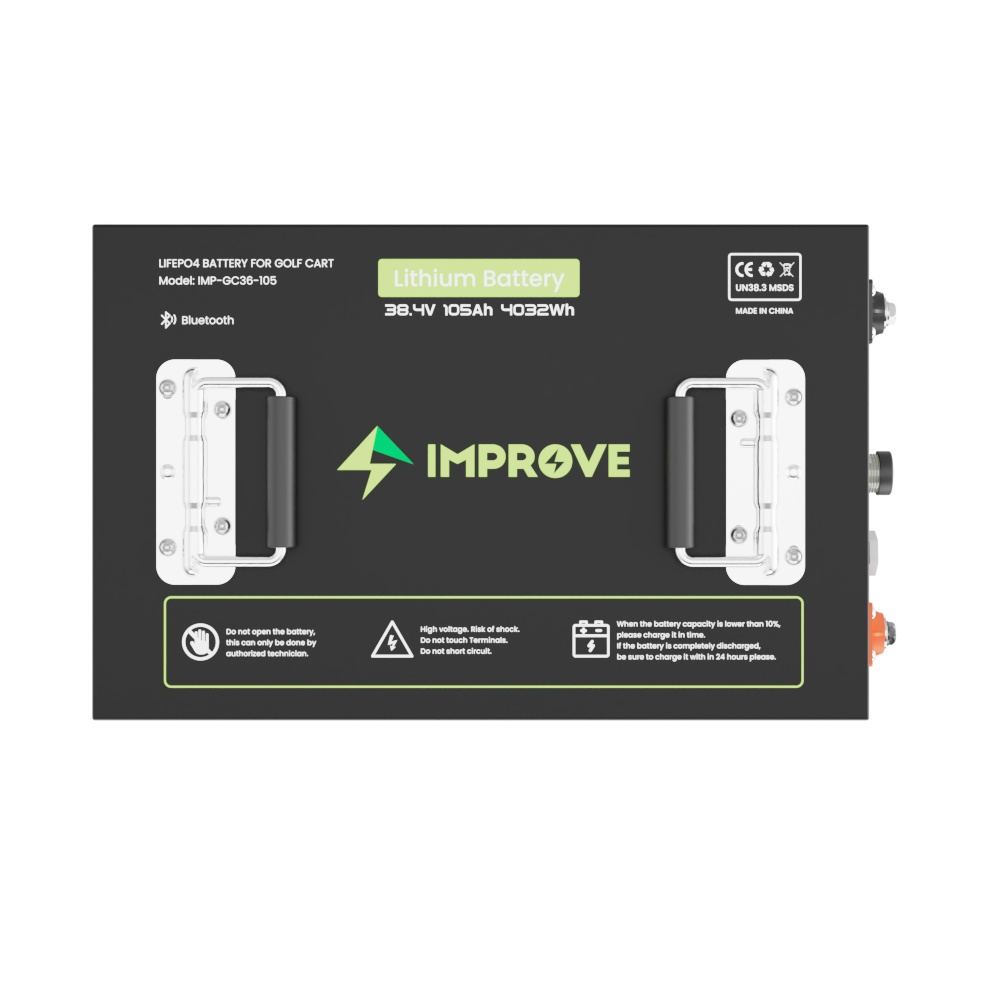
36V golf cart LiFePO4 battery
36V golf cart LiFePO4 battery from the manufacturer's published range.
12.8VRV & packs
25.6V24V systems
38.4V36V motive
51.2VStorage & 48V
Specification Plate

Key specifications

Cost layer 1 - the batteryLead-acid bank: lower purchase price. LiFePO4 pack: higher purchase price (varies by voltage and capacity; quoted per model)
Cost layer 2 - supporting partsLithium: LiFePO4-profile charger + state-of-charge metering + fitting. Lead-acid: charger reused; labour higher (multiple heavy units)
Cost layer 3 - repetitionLead-acid: bank replaced every few seasons in regular service (general figure). LiFePO4: thousands of cycles, decade-class planning life
Maintenance costLead-acid: watering, terminal cleaning, corrosion damage. LiFePO4: none of the three
Hidden performance costA fading lead bank loses range long before it dies - the cost shows up as a cart that cannot finish its day
Resale/scrap offsetSpent lead-acid has recycling value; lithium packs hold residual value longer due to service life

Figures are the manufacturer's published data for this range. The written quote states the exact configuration of your build.

Why It Earns Its Place

Features

Price the decade, not the day

Write both options as total spend over your planned ownership: battery + forced parts + expected replacements + maintenance time. The winner is usually obvious once the years are in the table.

Fleets feel layer three first

For a resort or rental fleet, watering labour, acid damage and mid-season bank failures are operating costs with payroll attached. That is why fleets convert earliest.

Charger honesty

Any lithium quote that excludes the charger is not a lower quote - it is an incomplete one. The matched-set quote is the only comparable number.

Capacity is a cost decision too

A 105Ah-class pack and a smaller pack are different tools. Oversizing wastes money; undersizing wastes the conversion. Duty decides - rounds per day, terrain, passenger load.

A worked way to think about it

Take a private cart used a few times a week. The lead option: bank price, fitting, then repeat in roughly three to four seasons, with watering in between. The lithium option: pack plus charger plus meter, fitted once, then essentially forgotten for the cart's remaining life. Take a fleet cart used daily: the lead bank's life shortens, the watering rounds multiply across dozens of carts, and one mid-season failure costs a rental day. In both cases the arithmetic is the same shape - lithium front-loads the spend and deletes the repetition - and the crossover arrives sooner the harder the cart works.

Questions to ask any seller (including us)

Is the charger included, and is it a lithium profile matched to this voltage? Is state-of-charge metering included or an extra? What is the pack's cycle rating and at what depth of discharge - in writing? What is the pack's weight, and does fitting require tray work? What exactly does the warranty cover, and who honours it locally? A seller who answers all five in writing has quoted you a system; anything less is a battery in a box.

Ordering & OEM

How ordering works

Minimum order quantities and lead times depend on the product type and the degree of customisation: standard products can start from smaller batches, while custom housings, labelling and packaging are assessed per project. Samples can be arranged, with sample and freight costs confirmed against the requirement. Every enquiry is answered with a written specification and quote stating the model, configuration and terms - nothing about an order here is left to chat messages.

Improve Battery runs OEM/ODM alongside its standard range, and ships with the export documentation each model carries (CE, RoHS, FCC, MSDS, UN38.3 types as listed per datasheet; certificates available upon request). State the model, voltage, quantity and destination in the enquiry form and the sales team in Shenzhen will reply with the full specification.

Questions

Frequently asked

Why won't this page just give a price?

Because a real price depends on voltage, capacity, charger and destination - and a manufacturer who prints one number for all of them is inventing it. Send the cart details and the quote you get is a written, itemised number.

Is lithium worth it for a cart I use monthly?

Light use stretches lead-acid's calendar life and shrinks lithium's cycle advantage. The honest answer: for very light private use the lead bank can be the rational spend; the crossover comes with regular use.

Can I replace just one failed lead battery instead?

You can, and it is the cheapest day-one fix - but a new unit in an old bank is dragged down by its neighbours and usually fails early. It buys a season, not a solution.

What does conversion do to cart value?

A documented lithium conversion with matched charger generally supports resale value in markets that understand the chemistry, because the buyer inherits a decade-class battery instead of a pending replacement bill.

Related pages

Tell us the model. We price it in writing.

Model, voltage, quantity and destination - that is all a real quote needs.

Get an Itemised Quote