A lithium conversion is three matched parts — the right-voltage LiFePO4 pack, a lithium-profile charger, and honest wiring. Here is how the conversion works on 36V, 48V and 72V carts.
Converting a golf cart from lead-acid to lithium is the single most effective upgrade a cart can get: the pack weighs a fraction of the flooded bank it replaces, holds its voltage under load instead of sagging, charges in hours instead of overnight, and asks for no watering, no acid and no terminal scrubbing. The manufacturer's golf cart range — 36V, 48V-class (51.2V) and 72V LiFePO4 packs, including the 105Ah reference capacity across all three voltages — exists precisely for this conversion market.
A proper conversion has three parts. First, the battery: voltage must match the cart's system (36V, 48V or 72V), and capacity is chosen by duty — a neighbourhood cart and a resort workhorse do not need the same amp-hours. Second, the charger: lead-acid charge profiles undercharge lithium and can trip its protection, so the conversion uses a charger with a LiFePO4 profile — the manufacturer's charger range covers 48V LiFePO4 charging. Third, the details: state of charge metering (a lithium pack's flat voltage curve makes the old lead-acid gauge lie), cabling rated for the current, and secure mounting for a much lighter pack.
Fleet buyers — resorts, golf courses, campuses, rental operators — convert for the operating maths: no watering labour, no acid-damaged floors, faster turnaround charging, and a pack life measured in thousands of cycles rather than a few seasons of flooded cells.
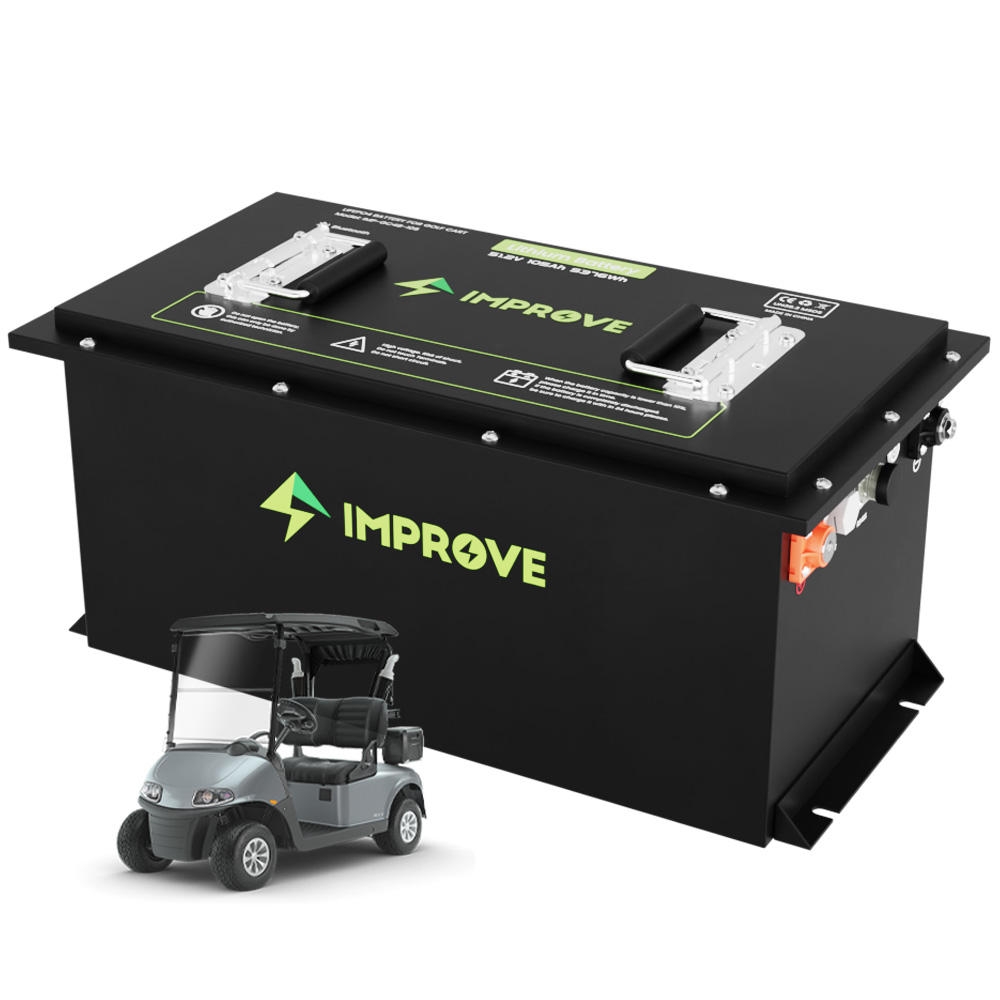
| Cart voltages covered | 36V · 48V class (51.2V) · 72V LiFePO4 packs |
|---|---|
| Reference capacity | 105Ah builds across the golf cart range (model data per product page) |
| Charging | LiFePO4-profile chargers; 48V lifepo4 charger data published (58.4V class) |
| Weight | A lithium pack typically weighs roughly a third of the lead-acid bank it replaces (general figure; per-model weights on product pages) |
| Maintenance | No watering, no acid, no equalisation charges |
| Cycle life | LiFePO4 rated in thousands of cycles; per-model figures on product pages |
Figures are the manufacturer's published data for this range. The written quote states the exact configuration of your build.
The cart keeps its motor and controller; the conversion matches pack voltage to the existing system — 36, 48 or 72 volts.
Budgeting battery-only is the classic conversion mistake. A lithium-profile charger protects the pack and actually fills it.
Removing 100kg+ of lead changes acceleration, braking and tyre wear for the better — and frees payload for passengers and cargo.
For operators, the saving is labour and downtime: no watering rounds, no corrosion cleanup, opportunity charging between rounds.
One: confirm the cart's system voltage and measure the battery tray — the pack must fit the space the lead bank occupied, or a tray adaptation is planned. Two: choose capacity by duty cycle; a cart doing two rounds a day on hilly ground wants more amp-hours than a flat-course single-round cart. Three: pair the pack with the correct lithium-profile charger and a state-of-charge meter that reads the pack's data rather than guessing from voltage. Four: install, secure, and load-test.
Everything except the physical installation can be settled in the enquiry: send the cart make, model, voltage and duty, and the quote names the pack, the charger and the meter as one matched set.
A tired motor, worn controller or bad bearings stay tired after conversion — lithium improves the energy system, not the whole cart. And a conversion done with an unmatched charger or an undersized pack for the duty will disappoint in ways that get blamed on the chemistry. The matched-set approach exists to keep that from happening.
Minimum order quantities and lead times depend on the product type and the degree of customisation: standard products can start from smaller batches, while custom housings, labelling and packaging are assessed per project. Samples can be arranged, with sample and freight costs confirmed against the requirement. Every enquiry is answered with a written specification and quote stating the model, configuration and terms - nothing about an order here is left to chat messages.
Improve Battery runs OEM/ODM alongside its standard range, and ships with the export documentation each model carries (CE, RoHS, FCC, MSDS, UN38.3 types as listed per datasheet; certificates available upon request). State the model, voltage, quantity and destination in the enquiry form and the sales team in Shenzhen will reply with the full specification.
Not safely or effectively. Lead-acid profiles and lithium requirements differ; the conversion quote includes the correct charger so the question never becomes a warranty argument.
Range depends on terrain, load, tyres and driving style. As a planning figure, a 48V-class 105Ah pack stores about 5.4kWh — send your duty profile and we will estimate honestly rather than quote a best-case number.
Top speed is set by the motor and controller, but a lithium cart holds speed on hills far better because its voltage does not sag under load the way lead-acid does.
Yes — fleet conversions are a core use of this range. State the fleet size, cart models and voltages; volume configuration and charger counts are quoted as one project.
Model, voltage, quantity and destination - that is all a real quote needs.