+86 177 2796 1215
Guides / What Is a LiFePO4 Battery?
Guide · The Basics

What Is a LiFePO4 Battery?

LiFePO4 is lithium iron phosphate: a lithium-ion chemistry whose cathode is built from iron and phosphate instead of cobalt or nickel. That one material choice explains its long life, its stability, and where it wins.

LiFePO4 stands for lithium iron phosphate, the cathode material in this family of rechargeable lithium batteries. Every lithium-ion battery moves lithium ions between two electrodes; what changes between chemistries is what those electrodes are made of, and the cathode material decides most of the battery's character - its voltage, its stability, its lifespan and its cost. In LiFePO4, the cathode is an iron-phosphate compound with a very stable crystal structure, and that stability is the whole story.

The practical consequences follow one by one. The nominal cell voltage is 3.2V, so packs are built in multiples: 12.8V from four cells, 25.6V from eight, 51.2V from sixteen - the voltage platforms you see across this manufacturer's range. The chemistry tolerates being cycled deeply, thousands of times: the storage datasheets in this range rate packs at 6,000 cycles or more at 80% depth of discharge. And because the cathode does not release oxygen easily when abused, LiFePO4 is far more resistant to thermal runaway than cobalt-based lithium chemistries, which is why it became the default for home storage, RVs and motive power.

What LiFePO4 is not: it is not the highest energy density chemistry, so it rarely powers phones or performance EVs where every gram counts. It trades some compactness for longevity and safety - the right trade wherever the battery is a fixture rather than a gadget: a home storage system, a golf cart pack, a forklift battery, a rack of backup power in a plant room.
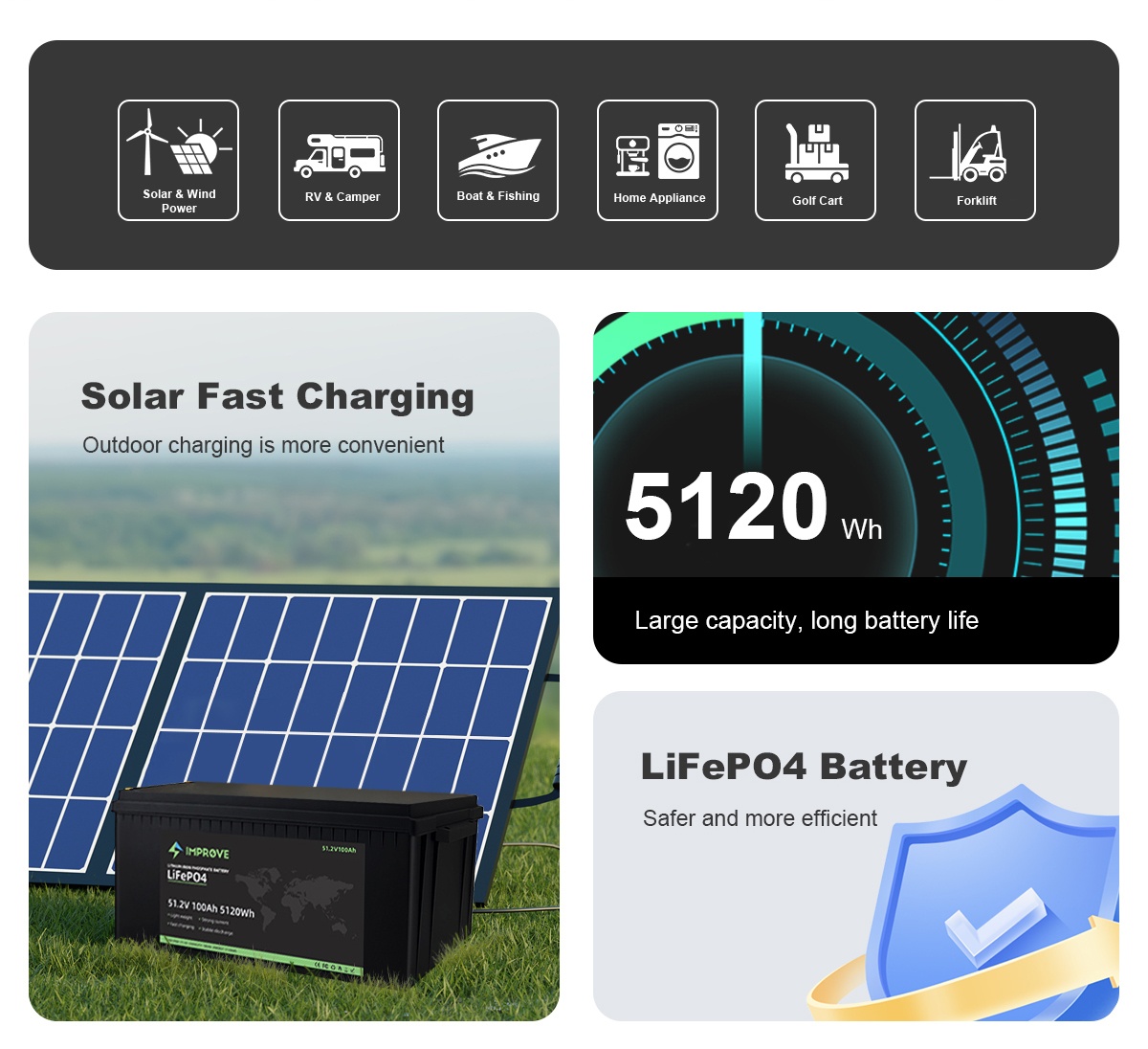
51.2V LiFePO4 battery pack
51.2V LiFePO4 battery pack from the manufacturer's published range.
12.8VRV & packs
25.6V24V systems
38.4V36V motive
51.2VStorage & 48V
Specification Plate

Key specifications

Cell voltage3.2V nominal per cell (general chemistry fact)
Common pack voltages12.8V / 25.6V / 38.4V / 51.2V (4 / 8 / 12 / 16 cells in series)
Cycle lifeThousands of cycles; this range's storage datasheets state 6,000+ at 80% DOD
Thermal behaviourIron-phosphate cathode is inherently more stable than cobalt-based cathodes (general chemistry fact)
Self-dischargeLow - a few percent per month in typical conditions (general figure)
Operating roleDeep-cycle service: storage, motive power, RV and marine house banks

Figures are the manufacturer's published data for this range. The written quote states the exact configuration of your build.

Why It Earns Its Place

Features

Longevity first

The chemistry's stable cathode degrades slowly, which is why LiFePO4 became the deep-cycle standard: the battery is bought once and cycled for a decade-class service life.

Safety by material

Thermal stability is a property of the iron-phosphate bond itself, not of added protection electronics - though every pack here still carries a full BMS.

Honest voltage steps

The 3.2V cell makes pack voltages land on the 12.8/25.6/51.2V steps that directly replace 12/24/48V lead-acid systems.

Cost without cobalt or nickel

Iron and phosphate are abundant, cheap materials; the pack price is dominated by manufacturing quality, not exotic metals.

How a LiFePO4 pack is built

Cells are only the start. A finished pack adds a battery management system (BMS) that watches every cell group's voltage, temperature and current, balances the cells, and disconnects the pack if anything leaves the safe window; a steel or aluminium enclosure; and, on the systems in this range, communication ports (RS485, CAN) so inverters and controllers can read the battery's state directly. When you compare two LiFePO4 batteries at different prices, you are usually comparing these layers, not the cells alone.

That is also why this manufacturer's range is organised by application format - stackable bricks, wall-mounted powerwall units, rack batteries, cart and RV packs - rather than by cell: the chemistry is constant, the engineering around it is what each duty actually buys.

Where LiFePO4 is used

Home and commercial energy storage is the largest home for the chemistry today, because the duty - one deep cycle a day for years - plays directly to its lifespan. Motive power follows: golf carts, forklifts, AGVs, floor scrubbers and UTVs, where weight and opportunity charging matter. RV and caravan house banks are the third classic duty, replacing lead-acid banks that weighed twice as much for half the usable energy. Standby and telecom backup round out the list, trading the old float-duty lead-acid bank for a system that can also cycle when needed.

Ordering & OEM

How ordering works

Minimum order quantities and lead times depend on the product type and the degree of customisation: standard products can start from smaller batches, while custom housings, labelling and packaging are assessed per project. Samples can be arranged, with sample and freight costs confirmed against the requirement. Every enquiry is answered with a written specification and quote stating the model, configuration and terms - nothing about an order here is left to chat messages.

Improve Battery runs OEM/ODM alongside its standard range, and ships with the export documentation each model carries (CE, RoHS, FCC, MSDS, UN38.3 types as listed per datasheet; certificates available upon request). State the model, voltage, quantity and destination in the enquiry form and the sales team in Shenzhen will reply with the full specification.

Questions

Frequently asked

Is LiFePO4 the same as lithium-ion?

LiFePO4 is one member of the lithium-ion family. When people say 'lithium-ion' loosely they usually mean the cobalt-based chemistries in phones and laptops; LiFePO4 is the iron-based member, with lower voltage per cell, longer life and higher stability.

Why is the voltage 12.8V instead of 12V?

Four 3.2V cells in series give 12.8V nominal. That sits comfortably inside the operating window of equipment designed for 12V lead-acid, which is why LiFePO4 works as a lead-acid replacement class.

Can LiFePO4 catch fire?

No battery is fireproof, but the iron-phosphate cathode is substantially more resistant to thermal runaway than cobalt-based chemistries, and the BMS adds electronic protection on top of the material safety.

What does the BMS actually do?

It monitors voltage, current and temperature, balances cells, and cuts the pack off outside safe limits. It is the difference between a box of cells and a battery.

Related pages

Tell us the model. We price it in writing.

Model, voltage, quantity and destination - that is all a real quote needs.

Ask About a Pack