The high-voltage cart battery: 73.6V, 105Ah, 7.73kWh — for performance carts, LSVs and utility vehicles that outgrew 48V.
Seventy-two-volt carts exist for torque and range, and their batteries have to match. The IMP-GC72-105 delivers 73.6V nominal at 105Ah — 7,728Wh — in a 547 × 287 × 254.5mm enclosure of about 72kg. Discharge manners match the rest of the GC family at fleet grade: 200A continuous, 400A peak for 30 seconds, against an 83.95V charge voltage and 60.95V cut-off. Cycle life is 6,000 cycles or more at 80% depth of discharge.
Capacity across the 72V line runs 72Ah to 320Ah, customisable, with adjustable enclosure dimensions — the platform answer for low-speed vehicles, hunting and utility carts, airport and resort transport, and the growing class of high-specification neighbourhood vehicles that ship on 72V architectures. Terminals are M8 female with Anderson or REMA options; communication options are Bluetooth, CAN, RS485 and LCD; IP54 is standard and IP65 optional.
Fleet buyers running mixed voltages will find the family's discipline useful: the 36V, 48V and 72V lines share datasheet structure, option sets and cycle ratings, so a single supplier conversation can specify an entire mixed fleet — and a single documentation format serves the whole conversion programme.
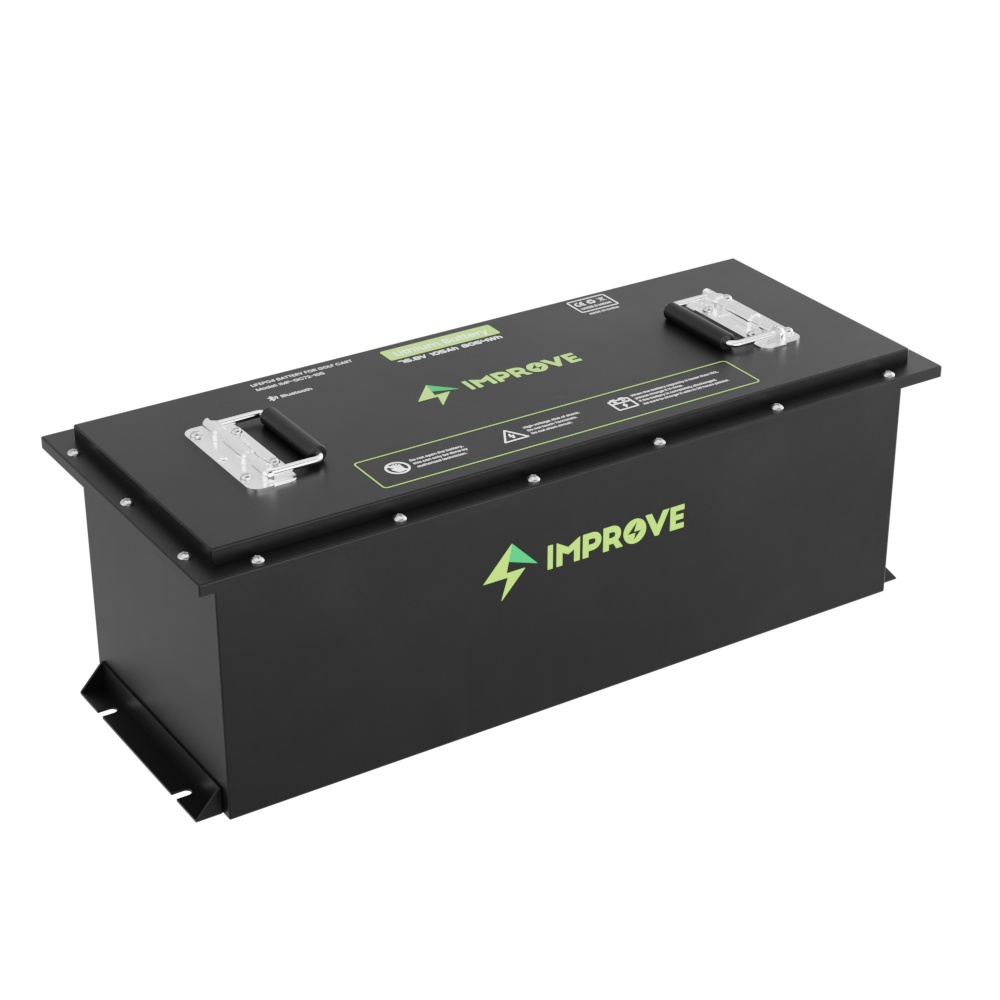
| Reference model | IMP-GC72-105 |
|---|---|
| Nominal voltage / capacity / energy | 73.6V · 105Ah · 7,728Wh |
| Dimensions / weight | 547 × 287 × 254.5mm · approx. 72kg |
| Capacity range | 72Ah–320Ah, customisable; enclosure customisable |
| Cycle life | 6,000 cycles or more (80% DOD, 25°C) |
| Charge voltage / cut-off | 83.95V / 60.95V |
| Max discharge | 200A continuous · 400A peak (30s) |
| Terminals / communication | M8 female (Anderson / REMA optional) · Bluetooth / CAN / RS485 / LCD optional |
| Certification (published) | CE, RoHS, FCC, MSDS, UN38.3; certificates available upon request |
Figures are the manufacturer's published data for this range. The written quote states the exact configuration of your build.
Energy density that gives high-voltage carts their range without a lead-acid mass penalty in the tray.
400A for 30 seconds covers loaded starts and grades on utility routes, not just flat fairways.
Mixed-fleet operators specify 36/48/72V from a single datasheet discipline and a single supplier.
Long-route and commercial-duty builds step up within the same platform.
Long routes, hills, passenger loads and utility work punish voltage sag; the 72V architecture holds speed and torque deeper into the discharge curve. If your fleet's duty cycle is flat and short, the 48V line is the economical answer — the quote process will say so when the route data points that way. Bring the vehicle list and the route profile; the voltage recommendation comes back with the reasoning shown.
Minimum order quantities and lead times depend on the product type and the degree of customisation: standard products can start from smaller batches, while custom housings, labelling and packaging are assessed per project. Samples can be arranged, with sample and freight costs confirmed against the requirement. Every enquiry is answered with a written specification and quote stating the model, configuration and terms - nothing about an order here is left to chat messages.
Improve Battery runs OEM/ODM alongside its standard range, and ships with the export documentation each model carries (CE, RoHS, FCC, MSDS, UN38.3 types as listed per datasheet; certificates available upon request). State the model, voltage, quantity and destination in the enquiry form and the sales team in Shenzhen will reply with the full specification.
The battery is a component; vehicle compliance rests on the vehicle. The pack's published data — voltage window, currents, IP rating, certifications listed — is what your vehicle documentation needs from the battery side.
Electrically the 73.6V nominal matches a 72V system's lithium profile. Tray fit and charger replacement are the two checks — both covered in the conversion quote.
320Ah within the customisable range. Above standard references, capacity and enclosure are quoted per vehicle.
Model, voltage, quantity and destination - that is all a real quote needs.