The legacy-fleet battery: 38.4V, 105Ah reference build, keeping 36V carts in service with lithium range, lithium weight and a 6,000-cycle life.
Thousands of serviceable carts still run 36V systems, and their owners face a poor choice: keep feeding them lead-acid packs, or scrap good vehicles. The IMP-GC36-105 is the third option — a 38.4V LiFePO4 build at 105Ah (4,032Wh) in a 423 × 270 × 259.5mm enclosure weighing about 34kg, with the same electrical manners as its 48V and 72V sisters: 43.8V charge, 31.8V cut-off, 100A maximum continuous charge, 200A continuous discharge and 400A peak for 30 seconds.
The capacity range runs 72Ah to 320Ah, customisable, with enclosure dimensions adjustable — the two properties that matter when the battery has to fit a twenty-year-old tray design. Cycle life is 6,000 cycles or more at 80% DOD, which for a cart working daily rounds is a decade-class component. M8 female terminals come standard with Anderson or REMA plugs as options; Bluetooth, CAN, RS485 and LCD are the published communication options; IP54 is standard with IP65 available.
For conversion shops, the 36V line is steady work: resorts, campuses, retirement communities and rental fleets full of mechanically sound carts whose only failing part is a battery chemistry from another era. One supplier covers the conversion — battery, matched charging guidance and documentation — across 36V, 48V and 72V fleets alike.
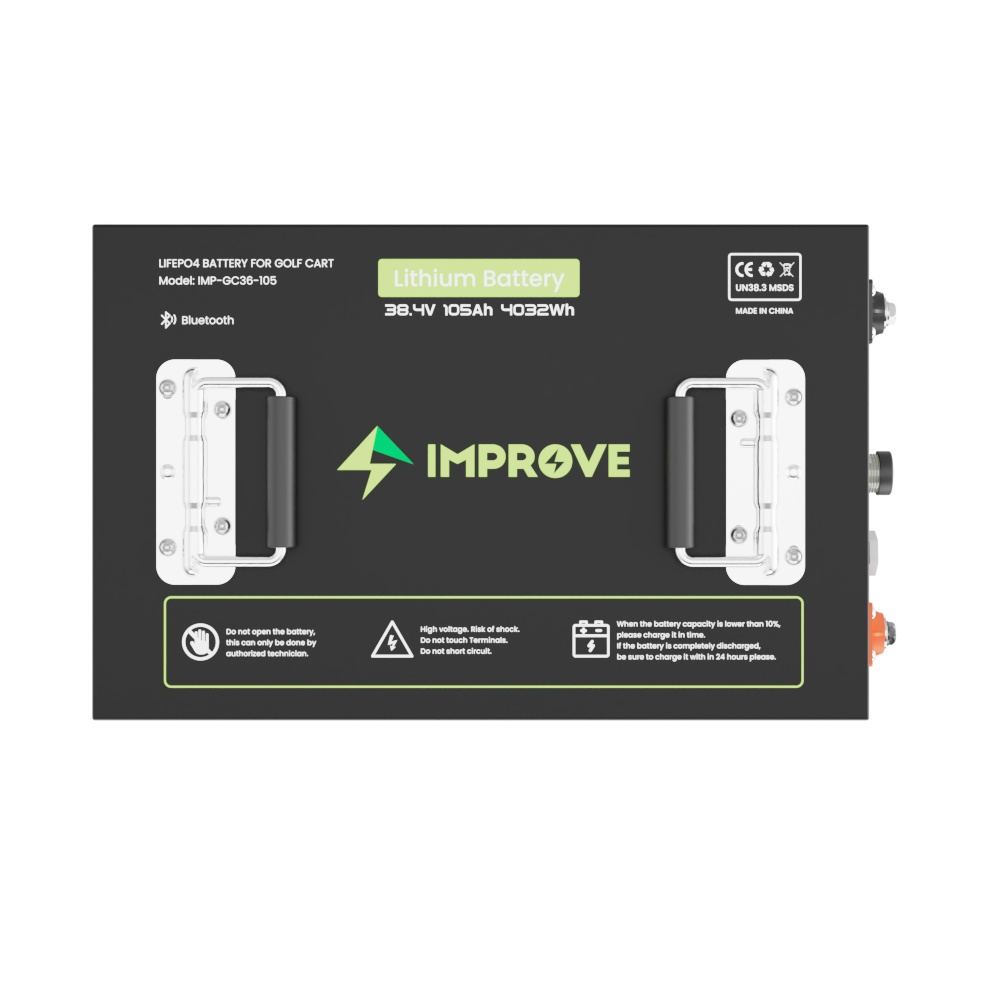
| Reference model | IMP-GC36-105 |
|---|---|
| Nominal voltage / capacity / energy | 38.4V · 105Ah · 4,032Wh |
| Dimensions / weight | 423 × 270 × 259.5mm · approx. 34kg (75lb) |
| Capacity range | 72Ah–320Ah, customisable; enclosure customisable |
| Cycle life | 6,000 cycles or more (80% DOD, 25°C) |
| Charge voltage / cut-off | 43.8V / 31.8V |
| Max discharge | 200A continuous · 400A peak (30s) |
| Terminals / communication | M8 female (Anderson / REMA optional) · Bluetooth / CAN / RS485 / LCD optional |
| Certification (published) | CE, RoHS, FCC, MSDS, UN38.3; certificates available upon request |
Figures are the manufacturer's published data for this range. The written quote states the exact configuration of your build.
Customisable enclosure and capacity meet old tray dimensions instead of forcing vehicle modifications.
400A peak and 200A continuous keep converted carts strong on hills with passengers aboard.
One person can handle the swap that used to need two people and a lifting strap for six lead-acid blocks.
For carts that live outdoors year-round, the enclosure protection steps up at order level.
The work is a specification, not a surgery: confirm the tray dimensions, the daily route and the charger situation, and the quote returns battery, capacity recommendation and charging pairing per vehicle type. The conversion guide on this site works through the numbers — weight removed, cycles gained, cost per season — that fleet managers use to justify the programme.
Minimum order quantities and lead times depend on the product type and the degree of customisation: standard products can start from smaller batches, while custom housings, labelling and packaging are assessed per project. Samples can be arranged, with sample and freight costs confirmed against the requirement. Every enquiry is answered with a written specification and quote stating the model, configuration and terms - nothing about an order here is left to chat messages.
Improve Battery runs OEM/ODM alongside its standard range, and ships with the export documentation each model carries (CE, RoHS, FCC, MSDS, UN38.3 types as listed per datasheet; certificates available upon request). State the model, voltage, quantity and destination in the enquiry form and the sales team in Shenzhen will reply with the full specification.
The battery presents 38.4V nominal with a 43.8V charge — the standard LiFePO4 profile for 36V systems. Send your controller model in the enquiry for a written compatibility confirmation.
The range runs to 320Ah with customisable enclosures. Whether a given capacity fits a given tray is a dimensions question — send the tray measurements.
A LiFePO4-profile charger at 43.8V. Lead-acid chargers are not suitable; matched charging options are covered in the quote.
Model, voltage, quantity and destination - that is all a real quote needs.