The chargers specified with the forklift packs: four ADY models from 48Vdc units to 9kW and 12kW machines, with CAN-protocol charging where the battery calls for it.
A lithium forklift fleet lives or dies by its charging. The IMP-ADY series is the charger family the manufacturer publishes with its forklift packs: the IMP-ADY6102 (48Vdc, 30/60Vdc window), the IMP-ADY6108 (48Vdc, 30–60Vdc window), and the high-power IMP-ADY6111 at 9kW and IMP-ADY6113 at 12kW for large packs and fast turnarounds.
The technically important line in the manufacturer's own documentation concerns protocol: with BMS charging, the CAN charging protocol is controlled by the battery's signal; without it, the protocol runs blind. That single distinction is why chargers and batteries are specified together in this catalogue rather than bought from separate shelves — a charger that cannot hear the pack cannot manage opportunity charging properly, and opportunity charging is the entire economic argument for lithium in materials handling.
Fleet buyers should treat this page as one half of a specification: the forklift battery page carries the packs (24/36/48V, customisable capacity), this page carries the machines that feed them, and the quote joins the two — charger model, count and placement matched to truck count, shift pattern and break windows. Charging infrastructure sized with the fleet, not after it, is what makes the multi-shift arithmetic real.
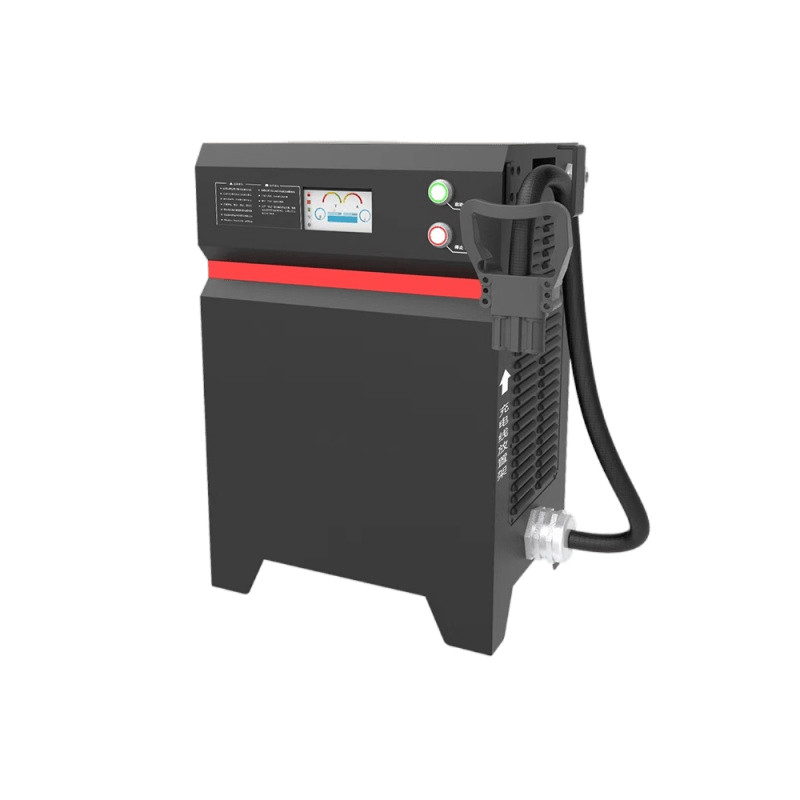
| IMP-ADY6102 | 48Vdc (30/60Vdc) |
|---|---|
| IMP-ADY6108 | 48Vdc (30–60Vdc) |
| IMP-ADY6111 | 9kW |
| IMP-ADY6113 | 12kW |
| Charging protocol | CAN charging with BMS control (per manufacturer documentation); non-BMS mode available |
| Matched packs | IMP-FK-24-200 · IMP-FK36-600 · IMP-FK48-200 and the industrial motive range |
| Role | Opportunity and full charging for lithium forklift fleets |
Figures are the manufacturer's published data for this range. The written quote states the exact configuration of your build.
CAN charging under BMS control — the battery directs its own charge instead of accepting a blind profile.
High-power models turn large packs around inside break windows and shift changes.
Charger count and model are part of the battery quote, matched to trucks and shifts — not an afterthought purchase.
Packs, chargers and the protocol between them come from one manufacturer and one documentation set.
The inputs are truck count, pack capacity, shift pattern and the length of natural breaks. A two-shift operation with hour-long breaks charges opportunistically on mid-power units; a three-shift operation with short windows steps to the 9kW and 12kW machines. Send the fleet list with the enquiry and the quote returns chargers as a line item with the reasoning visible — including when fewer chargers than expected will do.
Minimum order quantities and lead times depend on the product type and the degree of customisation: standard products can start from smaller batches, while custom housings, labelling and packaging are assessed per project. Samples can be arranged, with sample and freight costs confirmed against the requirement. Every enquiry is answered with a written specification and quote stating the model, configuration and terms - nothing about an order here is left to chat messages.
Improve Battery runs OEM/ODM alongside its standard range, and ships with the export documentation each model carries (CE, RoHS, FCC, MSDS, UN38.3 types as listed per datasheet; certificates available upon request). State the model, voltage, quantity and destination in the enquiry form and the sales team in Shenzhen will reply with the full specification.
They are specified for the manufacturer's packs and CAN protocol. For mixed fleets, state the pack details in the enquiry for a written compatibility answer.
Site electrical requirements are confirmed per model in the quote — the 9kW and 12kW classes need appropriate industrial supply, planned with the install.
Not necessarily: opportunity charging shares chargers across a fleet. The ratio comes from the shift arithmetic in the quote, not a rule of thumb.
Model, voltage, quantity and destination - that is all a real quote needs.